
Table of Contents
If you have ever wondered, do the driving modes in Cadillac LYRIQ offer different ranges or battery usages?, you are not alone. Many Cadillac LYRIQ owners notice that their estimated driving range changes after switching between Tour, Sport, Snow/Ice, or My Mode. This often creates confusion about whether the battery is actually being used differently or if the vehicle simply adjusts its performance.
The good news is that the answer is easier to understand than many people think. Driving modes do not increase or decrease the physical size of the battery. However, they can influence how efficiently the stored energy is used. Small changes in throttle response, power delivery, regenerative braking, and driving behavior can affect how far you travel on a single charge. Understanding these differences helps drivers enjoy better efficiency while still getting the performance they expect from Cadillac’s premium electric SUV.
Electric vehicles have changed the way people think about driving. Instead of focusing only on horsepower and fuel economy, EV owners now pay close attention to battery efficiency, charging habits, and energy management. Cadillac designed the LYRIQ with intelligent software that constantly balances performance, comfort, and efficiency. Every driving mode changes how the vehicle reacts to driver inputs rather than changing the battery itself.
Many first-time EV owners assume there must be a special “economy mode” that dramatically extends driving distance. Others believe Sport Mode automatically drains the battery much faster. In reality, the truth lies somewhere in between. Your driving habits usually have a much larger impact than the selected mode. Still, understanding what each setting actually changes can help you make smarter decisions during daily commutes, highway travel, or difficult weather conditions.
This guide explains exactly how every driving mode works, what happens behind the scenes, and how each setting influences energy consumption. By the end, you will understand when to use each mode, what affects battery efficiency the most, and how to maximize your Cadillac LYRIQ’s driving range.
Understanding Cadillac LYRIQ Driving Modes
Before discussing battery usage, it is important to understand why Cadillac includes multiple driving modes in the LYRIQ. These modes are designed to customize the driving experience instead of creating completely different vehicles. They adjust software settings that control acceleration, steering feel, traction management, and regenerative braking.
Although each mode changes the personality of the vehicle, the battery pack remains exactly the same. The Cadillac LYRIQ uses advanced battery management software that continually monitors temperature, energy flow, charging conditions, and power demand. The driving mode simply tells the system how aggressively or gently to deliver that available energy.
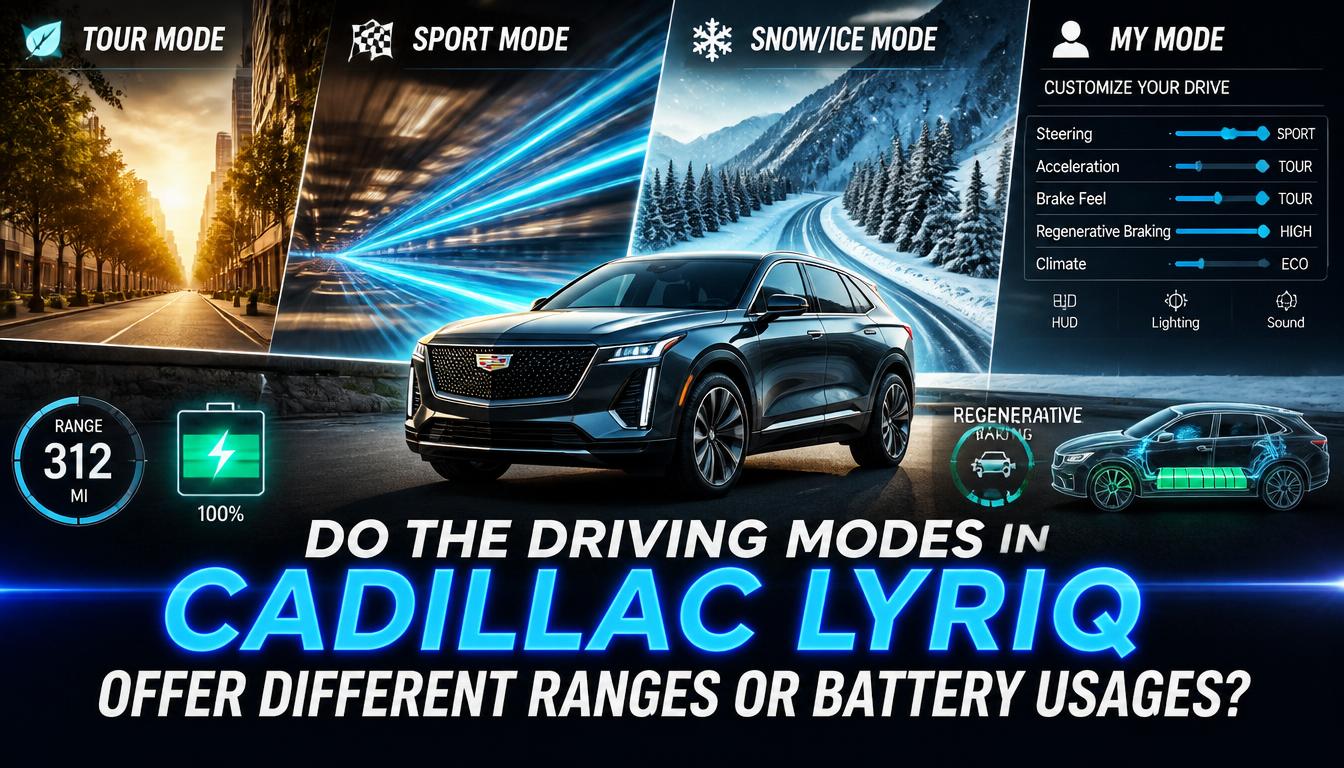
The LYRIQ offers four primary driving modes.
Tour Mode
Tour Mode is the default setting for most drivers. Cadillac developed this mode to provide the best balance between comfort, efficiency, and everyday usability.
Acceleration feels smooth rather than aggressive. Steering remains light enough for comfortable city driving while maintaining good highway stability. The electric motors deliver power progressively instead of instantly using maximum torque.
Because Tour Mode encourages smoother driving, many owners experience the closest results to the vehicle’s official EPA driving range estimates. It does not artificially limit the battery. Instead, it simply avoids encouraging unnecessary energy consumption.
For commuters and long-distance travelers, Tour Mode often becomes the preferred everyday setting because it delivers predictable performance while supporting efficient energy use.
Sport Mode
Sport Mode transforms the LYRIQ into a much more responsive electric SUV.
Throttle response becomes sharper, making even small accelerator inputs produce stronger acceleration. Steering typically feels heavier, giving drivers a more connected sensation while cornering.
Many drivers mistakenly think Sport Mode itself consumes more electricity. The reality is slightly different.
Sport Mode simply allows the electric motors to respond much more quickly. Because drivers naturally accelerate harder in this mode, energy demand increases. Higher acceleration requires more electrical power, which leads to greater battery consumption during spirited driving.
If a driver maintains gentle acceleration even while using Sport Mode, the efficiency difference may remain relatively small. However, repeated hard launches and aggressive passing maneuvers can noticeably reduce real-world driving range.
Snow/Ice Mode
Snow/Ice Mode focuses almost entirely on safety.
Driving on slippery roads requires careful control of wheel torque. Instead of allowing maximum acceleration, the LYRIQ softens throttle response and carefully distributes power to reduce wheel spin.
Traction control systems become more active, helping maintain vehicle stability on snow-covered or icy roads.
Many people wonder whether this mode improves efficiency. Under ideal conditions, the answer is generally no. Snow/Ice Mode is designed to maximize traction instead of maximizing range.
However, preventing unnecessary wheel spin can reduce wasted energy during extremely slippery conditions. In those situations, smoother power delivery may indirectly improve efficiency compared with aggressive acceleration that causes tires to lose traction.
My Mode
My Mode gives owners the ability to personalize several vehicle characteristics.
Drivers can customize steering feel, acceleration response, braking characteristics, and other settings according to personal preference.
This flexibility makes My Mode unique because there is no single answer regarding efficiency.
Someone who selects softer acceleration and relaxed steering may create a setup very similar to Tour Mode.
Another driver who chooses aggressive acceleration settings may build something almost identical to Sport Mode.
Because of this customization, battery usage depends entirely on how the vehicle has been configured.
How Driving Modes Influence Battery Usage
Many owners continue asking, do the driving modes in Cadillac LYRIQ offer different ranges or battery usages? The most accurate answer is that driving modes influence energy consumption rather than changing battery capacity.
Think about the battery as a water tank.
The size of the tank never changes.
What changes is how quickly the water flows out.
Driving modes affect how rapidly electrical energy leaves the battery during acceleration, climbing hills, highway driving, and stop-and-go traffic.
Smooth acceleration requires less power than aggressive acceleration.
Gentle throttle inputs reduce current flowing from the battery.
Rapid acceleration demands much larger bursts of electrical energy.
The battery itself remains identical in every situation.
Only the rate of consumption changes.
This distinction helps explain why many drivers notice changing range estimates after selecting different modes.
The dashboard is constantly calculating expected driving distance based on recent energy consumption. If recent driving becomes more aggressive, the computer predicts that future driving will continue similarly.
As a result, the displayed range estimate changes even though battery percentage remains almost identical.
Why Driving Habits Matter More Than Driving Modes
One of the biggest misunderstandings among EV owners is assuming that the selected driving mode determines overall efficiency.
In reality, driving behavior usually has a much greater influence than software settings.
Consider two different drivers using exactly the same Cadillac LYRIQ.
The first driver accelerates gently, anticipates traffic, maintains consistent highway speeds, and avoids sudden braking.
The second driver frequently launches quickly from traffic lights, accelerates aggressively, and drives well above highway speed limits.
Even if both drivers use Tour Mode, their battery consumption will differ dramatically.
Likewise, a calm driver using Sport Mode may actually achieve better efficiency than an aggressive driver using Tour Mode.
This illustrates an important principle of electric vehicle ownership.
The software helps shape vehicle behavior.
The driver ultimately determines how much energy is consumed.
Furthermore, maintaining steady speeds on highways often contributes more to efficiency than selecting a particular driving mode. Aerodynamic resistance increases rapidly as speed rises, requiring significantly more battery power to maintain momentum.
Because of this, reducing highway speed by only a small amount often produces larger efficiency gains than switching between Tour and Sport modes.
Expert Insight
According to EV engineering experts, “Driving modes primarily influence vehicle responsiveness rather than battery capacity. Long-term efficiency depends far more on consistent driving habits, speed management, and environmental conditions than on the selected drive mode alone.”
This perspective aligns with modern electric vehicle design philosophy, where intelligent software assists the driver but cannot overcome inefficient driving behavior.
The Biggest Factors That Affect Cadillac LYRIQ Range
Although many drivers ask, do the driving modes in Cadillac LYRIQ offer different ranges or battery usages?, the reality is that several other factors usually have a greater effect on battery performance. Understanding these influences allows owners to get the most from every charge.
Driving Speed
Speed is one of the largest contributors to energy consumption in any electric vehicle. At higher speeds, wind resistance increases dramatically, forcing the electric motors to work harder. This additional workload requires more electricity from the battery.
Driving at a steady highway speed often produces better efficiency than constantly accelerating and slowing down. Likewise, reducing cruising speed slightly on long trips can noticeably improve total driving distance.
Outside Temperature
Battery performance changes with temperature. Cold weather slows the chemical reactions inside lithium-ion batteries, reducing efficiency until the battery reaches its ideal operating temperature. Meanwhile, very hot weather requires the battery cooling system to work harder.
Climate control also consumes energy. Heating the cabin during winter or cooling it during summer draws electricity from the same battery that powers the vehicle. As a result, seasonal conditions often have a greater impact than any selected driving mode.
Road Conditions
Flat roads generally require less energy than steep hills. Climbing long grades demands significant electrical power, while downhill sections allow regenerative braking to recover some energy.
However, recovered energy rarely equals the amount required for the climb. Therefore, mountainous routes typically reduce overall efficiency compared with driving on level highways.
Vehicle Load
Extra passengers, luggage, or cargo increase the vehicle’s total weight. A heavier vehicle requires more energy during acceleration and while climbing hills.
Although the LYRIQ is engineered to handle additional weight comfortably, carrying unnecessary cargo for extended periods can slightly reduce efficiency.
How Regenerative Braking Helps Save Energy
One of the most valuable technologies in the Cadillac LYRIQ is regenerative braking.
Instead of wasting kinetic energy as heat during braking, the electric motors reverse their function and operate like generators. They convert part of the vehicle’s movement back into electrical energy, which is returned to the battery.
This process cannot recover every bit of energy, but it significantly improves overall efficiency, especially during city driving where frequent stops occur.
Cadillac also offers One-Pedal Driving, allowing drivers to slow the vehicle by simply lifting off the accelerator. This feature increases regenerative braking opportunities and reduces reliance on the traditional brake pedal.
When used smoothly, One-Pedal Driving can help improve efficiency during urban driving without affecting comfort.
Drivers should remember that regenerative braking performance varies depending on battery temperature and state of charge. A fully charged battery cannot always accept maximum regenerative energy, so recovery may temporarily decrease until battery capacity becomes available.
Simple Tips to Maximize Battery Efficiency
Improving battery efficiency does not require complicated techniques. Small adjustments in everyday driving habits often produce meaningful results over time.
Using Tour Mode for daily commuting remains one of the easiest ways to encourage smooth acceleration and predictable energy consumption. Gentle throttle inputs reduce unnecessary power demand, helping preserve battery charge.
Planning traffic movements ahead also improves efficiency. Gradual slowing allows regenerative braking to recover more energy than sudden braking. Likewise, maintaining a consistent speed instead of constantly accelerating helps reduce electricity consumption.
Charging habits also contribute to long-term battery health. Many electric vehicle specialists recommend charging to around 80 percent for routine daily driving while reserving full charges for longer trips. This practice reduces long-term battery stress and supports overall durability.
Regular tire pressure inspections are equally important. Underinflated tires increase rolling resistance, forcing the motors to consume more energy during every mile.
Software updates released by Cadillac should also be installed whenever available. These updates frequently improve battery management, charging performance, efficiency calculations, and overall vehicle operation.
Common Misunderstandings About Driving Modes
Several myths continue circulating among electric vehicle owners.
The first misconception is that Sport Mode automatically drains the battery much faster. In reality, the mode simply allows stronger acceleration. Drivers who remain gentle with the accelerator may notice only modest efficiency differences.
Another misunderstanding is believing Tour Mode unlocks additional battery capacity. The battery pack remains exactly the same regardless of the selected mode. Tour Mode simply encourages smoother energy usage.
Some owners also assume the dashboard range estimate is fixed. The estimate continuously changes because the computer analyzes recent driving behavior, environmental conditions, and average energy consumption.
It is also common to believe Snow/Ice Mode improves efficiency. This setting exists primarily to improve traction and stability on slippery roads. Any efficiency benefits are usually secondary to maintaining safe vehicle control.
Understanding these differences helps drivers interpret vehicle information more accurately and avoid unnecessary concern about changing range estimates.
Real-World Driving Scenarios
Imagine two LYRIQ owners beginning a 200-mile trip with identical battery levels.
The first driver selects Tour Mode, accelerates smoothly, maintains moderate highway speeds, and uses One-Pedal Driving whenever practical.
The second driver selects Sport Mode, accelerates aggressively after every traffic signal, frequently changes speed, and drives well above typical highway limits.
Although both vehicles contain identical batteries, the second driver will likely consume considerably more energy before reaching the destination.
Now consider another situation.
A calm driver selects Sport Mode but drives carefully throughout the journey.
Meanwhile, another driver remains in Tour Mode but constantly accelerates aggressively.
The calmer Sport Mode driver may actually finish the trip with more remaining battery.
These examples demonstrate an important lesson.
Driving habits influence efficiency more than the label displayed on the dashboard.
Why Cadillac Uses Multiple Driving Modes
Cadillac designed the LYRIQ to satisfy many different driving preferences without requiring owners to compromise.
Some drivers prioritize comfort during daily commuting. Others appreciate quick acceleration on open highways. Winter weather demands additional traction, while many owners enjoy customizing vehicle behavior according to personal preference.
Rather than changing the battery itself, Cadillac uses sophisticated software to modify how available power reaches the wheels.
This approach provides flexibility while allowing the battery management system to continue protecting battery health under every operating condition.
Modern electric vehicles increasingly rely on intelligent software instead of mechanical changes. As battery technology evolves, future driving modes may become even more adaptive by automatically responding to road conditions, traffic, navigation routes, and driver behavior.
Conclusion
So, do the driving modes in Cadillac LYRIQ offer different ranges or battery usages? The answer is yes, but not because the battery itself changes. Every driving mode adjusts how power is delivered, how quickly the vehicle responds to driver inputs, and how efficiently stored energy is used. Tour Mode generally provides the most balanced experience, while Sport Mode encourages stronger acceleration that may increase energy consumption. Snow/Ice Mode focuses on safety, and My Mode allows drivers to customize performance according to their preferences.
Ultimately, battery efficiency depends on much more than selecting a particular mode. Smooth acceleration, moderate speeds, weather conditions, regenerative braking, charging habits, and thoughtful driving techniques all contribute to real-world range. By understanding how these factors work together, Cadillac LYRIQ owners can confidently choose the right driving mode for every journey while maximizing efficiency and protecting long-term battery health.
Frequently Asked Questions
1. Do Cadillac LYRIQ driving modes change battery capacity?
No. Driving modes never change the battery’s physical capacity. They only adjust how efficiently the stored energy is used.
2. Which driving mode offers the best range?
Tour Mode usually delivers the most consistent balance between comfort, performance, and energy efficiency for everyday driving.
3. Does Sport Mode always reduce driving range?
Not necessarily. Sport Mode encourages faster acceleration, but careful driving can still produce efficient results.
4. Is My Mode better than Tour Mode for efficiency?
It depends on the settings. My Mode can match Tour Mode if configured for smooth acceleration and balanced performance.
5. Does One-Pedal Driving improve battery efficiency?
Yes. One-Pedal Driving increases regenerative braking opportunities and can recover additional energy, especially during city driving.